Your deals are moving while you’re not in the room.
Stay ahead of every decision.
01
Build the Deal Case
AI turns your conversations into decision-ready Deal Cases.
Recent calls detected4 ready
xCompany discovery callGoogle Meet · 34 min · 8 signals
Ramp expansion callZoom · 28 min · 6 signals
Dock ROI reviewGong · 42 min · 12 signals
Glow demo callTeams · 31 min · 7 signals
OpenAI security reviewGong · 46 min · 9 signals
Brex champion check-inGranola · 22 min · 5 signals
02
Send the Deal Case
Share your Deal Case with the right people at the right time.
 ▶1:22
▶1:22HubSpot pilot programChampion: Sarah Kim
 +2Ready to send
+2 ▶1:25
▶1:25Northstar AI projectChampion: Marcus Reed +3Ready to send
+3 ▶1:01
▶1:01AirCall ROI reviewChampion: Nikolai Ornikar
 +1Ready to send
+103
Follow the Deal
Track engagement, identify risks, and take action when it matters.

11x pilot programSarah watched 80% · 12m ago+2
+2Active
2
Air Europa GTMPeter viewed the case · 45m ago+3
+3In review
1
Front financeEugen commented · 1h ago+1
+1Decision motion
3Bollore ROI reviewCFO opened the case · 2h ago+2
+2Needs attention
1Build the Deal
Turn any sales conversation into a decision-ready Deal Case your champion can actually carry internally.
1
Capture conversation context
Start from notes, a transcript, a recording, or a connected conversation.
F
Fireflies connectedLatest calls are automatically available in Deal Drive.
Connected notetakers are managed in Settings → Notetakers.
Structuring call into 8 sections…
2
Deal Intelligence
Deal Drive understands the real buying context before shaping the narrative.
Deal snapshot
xCompany GTM system
Google Meet Notes · 31 min · Ivan Vakulenko / Wildix → Nikolai / xCompany
Champion detected
92% confidence
Stakeholder map
Who carries, influences, and needs alignment.
Wildix operator shaping the GTM system proposal.
→
Founder-led decision maker validating the need for structure.
→
Likely involved because the decision impacts growth, delivery capacity, and execution ownership.
Conversation timeline
Key moments detected from the source.
13-year xCompany history, 85 people, Dynamics focus.
No repeatable outbound or sales process.
Marketing, CRM and database exist but are underleveraged.
20% growth without damaging delivery.
ICP, triggers, TAM and segmented outbound become the missing layer.
Go deeper on ICPs, verticals and outbound structure.
Strategic readout
How this intelligence should shape the Deal Case.
Nikolai understands the opportunity, but needs decision-ready material to align internal stakeholders.
This is not just sales support. It touches ICP, outbound ownership, execution cadence and delivery capacity.
Package the GTM diagnosis, business risk, and first practical outbound motion for internal alignment.
3
Deal Script Engine
Based on the intelligence extracted from this call, Deal Drive recommends the best narrative strategy to help the champion move the deal internally — then builds the exact Deal Case script and asset logic for production.
Recommended narrative strategy
Position Wildix as the operating layer that turns xCompany’s existing growth assets into a repeatable GTM motion.
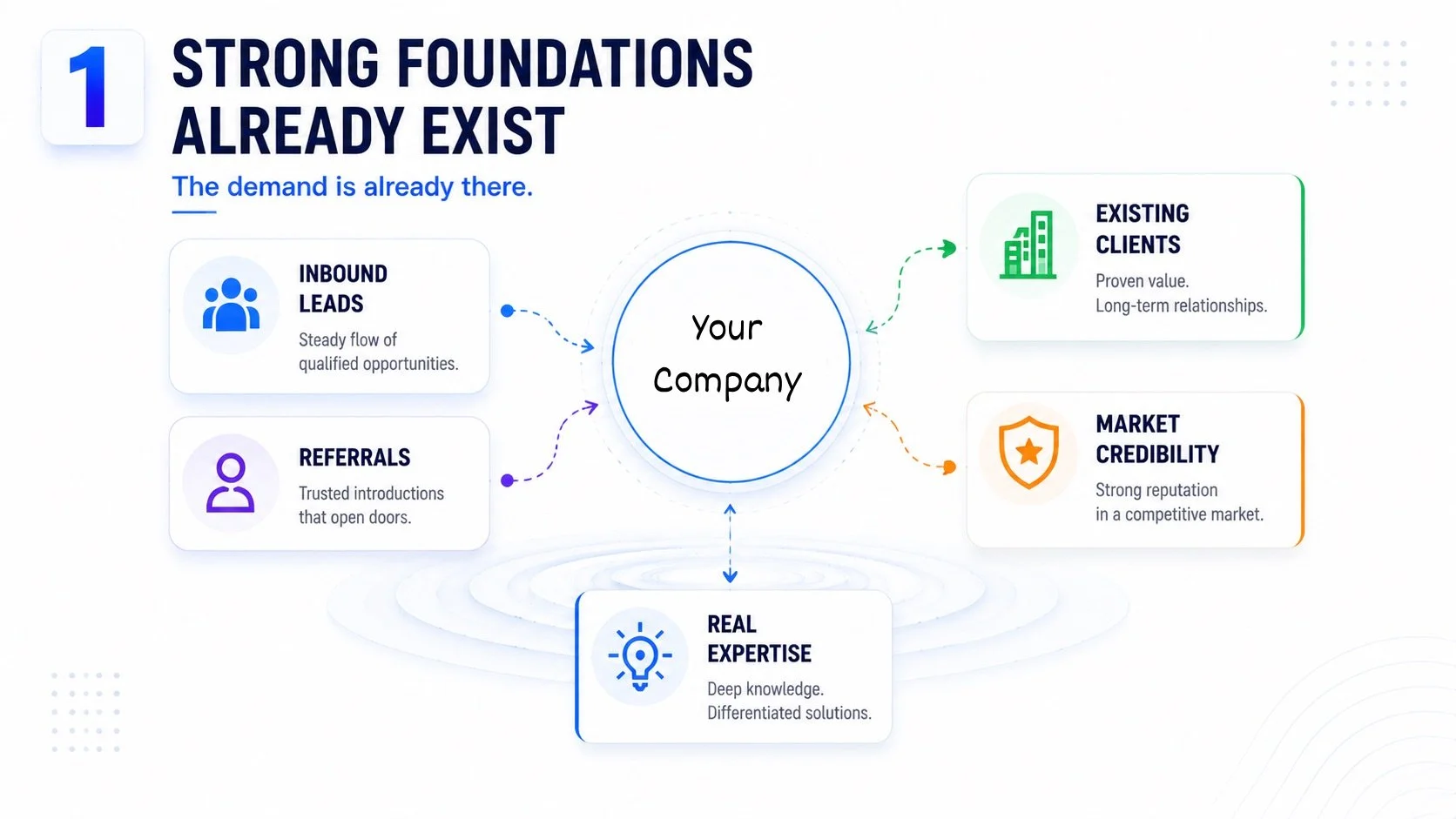
The strongest internal narrative is not “buy another tool.” It is: xCompany already has demand, credibility, customers, referrals, and domain expertise — but needs a controlled system to convert those assets into predictable pipeline without overloading delivery.
Champion-ready scene blueprint
Script + asset logic generated from the source and Deal Intelligence layer.
01
FoundationCreate confidence
You already have the assets for growth.
Ivan says
Nikolai, xCompany is not starting from zero. You already have expertise, customers, referrals, AppSource visibility, and a database that can be activated.
The opportunity is not to invent demand from scratch. The opportunity is to turn what already exists into a repeatable commercial motion.
Visual assetCompany asset map
Clients · Expertise · Referrals · AppSource · Database
02
Problem reframeClarify the real gap
The issue is not opportunity. It is repeatability.
Ivan says
Growth is already happening, but it still depends too much on relationships, manual follow-up, founder involvement, and scattered ownership.
That makes growth harder to forecast, harder to scale, and harder to transfer across the team.
Auto-generated visualGap comparison
Opportunistic growth vs. structured GTM system
03
Decision riskMake the hidden cost visible
Without structure, growth stays fragile.
Ivan says
The risk is not that xCompany lacks value. The risk is that value does not consistently become pipeline without structure around conversations, ownership, qualification, and follow-up.
That creates internal friction: leadership wants growth, delivery wants control, and the business needs a system that connects both.
Visual assetPropagation risk map
Leadership pressure · Delivery capacity · Sales ownership
04
Wildix solution mappingConnect product to pain
This is where Wildix becomes relevant.
Ivan says
Wildix is relevant because this is not only a lead-generation issue. It is an operating-layer issue around communication, engagement, follow-up, and team coordination.
Wildix helps create a more structured way for teams to manage conversations, capture intent, coordinate next steps, and keep customer-facing activity visible instead of fragmented.
Visual assetCapability mapping
Pain → Wildix capability → business outcome
05
Committee reassuranceNeutralize delivery concern
Growth should not create delivery chaos.
Ivan says
For your partners and delivery team, the goal is not uncontrolled demand. The goal is controlled growth with clear ICPs, qualification, visibility, and capacity-aware execution.
The point is to create a controlled GTM motion: clear ICPs, clear triggers, clear ownership, better visibility, and a follow-up cadence that protects delivery while making growth more predictable.
Asset from libraryControlled growth model
Focused ICPs · Qualification · Capacity-aware execution
06
Business outcomeConnect to ROI
A system makes growth more predictable.
Ivan says
If xCompany connects existing demand to structured engagement and follow-up, growth becomes less dependent on chance and individual effort.
That means stronger pipeline visibility, better internal accountability, more consistent customer engagement, and a more scalable growth engine as the company moves toward its next stage.
Visual assetOutcome scorecard
Visibility · Accountability · Predictability · Scalable growth
07
Internal next stepMove the champion forward
Align the team on the first growth motion.
Ivan says
The next step is a focused working session with the right stakeholders to define the first growth motion: ICPs, triggers, ownership, communication flow, and follow-up cadence.
That gives you a practical path to test the system, align the team, and prove that xCompany can turn existing growth assets into a repeatable operating model.
Visual assetNext-step workshop plan
Stakeholders · ICPs · Triggers · Ownership · Cadence
4
Production Studio
Configure how your Deal Case will be produced — avatar, voice, and visual environment.
If unchecked, Deal Drive generates a clean no-avatar Deal Case video. Background options appear only when avatar is enabled.
Choose your avatar9:16 digital twin previews
Choose your voicePreview or upload a voice profile
Choose visual environmentAvailable when avatar mode is enabled
5
Video Preview
Review the generated Deal Case before validation.
Rendering preview…
Deal Case ready to send.
Share the Deal
Move your Deal Case across the stakeholders shaping the decision.
Deal Case Video to send
This is the validated video produced in Build Deal Case.
Waiting for validated Deal Case from Build Deal Case.
PDF
Deal Summary PDFReady to forward internally
Decision context
Follow the Deal
See the buying conversation after the Deal Case is shared — signals, concerns, seller interventions, and decision momentum.
Decision events
What happened after Nikolai shared the Deal Case with the buying team.
✓
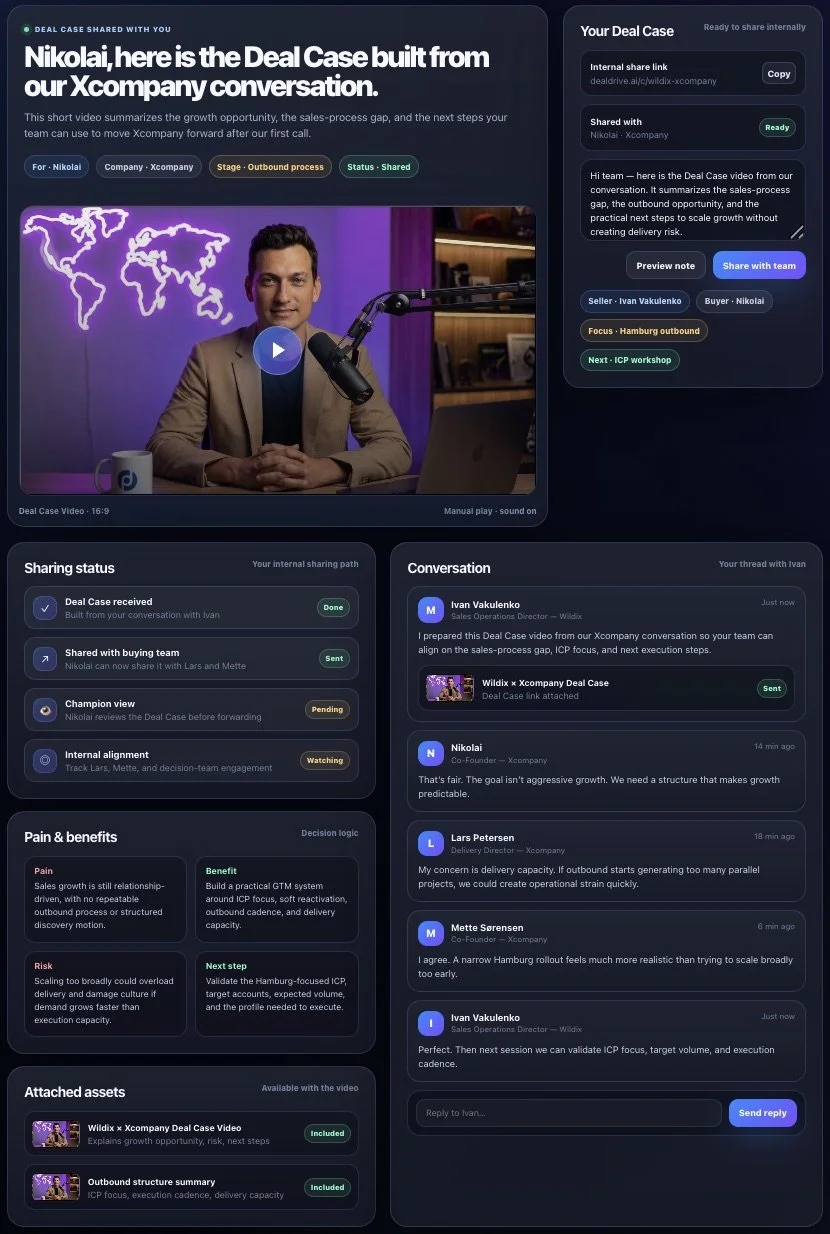
Deal Case sharedNikolai shared Ivan’s Deal Case with Lars and Mette.
9:12 AM✓
Buying team engagedLars and Mette reviewed the opportunity and entered the discussion.
10:08 AM!
Delivery concern raisedLars flagged that outbound momentum could create operational strain.
11:24 AM↗
Seller input recommendedDeal Drive recommended bringing Ivan in to clarify rollout constraints.
11:42 AM✓
Concern resolvedLars confirmed the delivery risk was addressed and Nikolai moved to ICP validation.
12:27 PMInternal decision threadStakeholder discussion, detected signals, and your input when needed.
You see the stakeholder messages that matter, the signal Deal Drive detected, and where your input was requested.
Lars Petersen
18 min agoDelivery Director — xCompany
My concern is delivery capacity. If outbound starts generating too many parallel projects, we could create operational strain quickly.
Nikolai
14 min agoCo-Founder — xCompany
That’s fair. The goal isn’t aggressive growth. We need a structure that makes growth predictable.
Mette Sørensen
10 min agoCo-Founder — xCompany
I agree. A narrow Hamburg rollout feels much more realistic than trying to scale broadly too early.
⚡
Signal detected
Your input requestedDelivery capacity concern raised by Lars.
Recommended action: Request seller input.Ivan Vakulenko
Input provided6 min agoSales Operations Director — Wildix
Thanks for raising this. The objective isn’t to maximize outbound volume. The model is built around delivery capacity first: narrow ICP, controlled outreach cadence, and clear capacity thresholds. The Hamburg rollout is designed to validate the model before expanding further.
Lars Petersen
Resolved3 min agoDelivery Director — xCompany
That helps. If rollout volume stays tied to delivery capacity and we start with a narrow Hamburg scope, I don’t see a delivery risk. I’m comfortable moving forward with the ICP and cadence discussion.
Nikolai
Just nowCo-Founder — xCompany
Great. Let’s move into ICP validation and rollout planning.
Your input requested
Stakeholders raised a delivery-capacity concern. Respond with additional context.
Assets
Equip your Deal Case with the visuals and proof points stakeholders need to understand, trust, and act.
▶
VideoxCompany footageSource footage · MOV
PDF
DocROI assumptionsFinance validation file
DOC
DocImplementation timelineNext-step document
ImageProduct screenshotVisual proof
↗
ImageROI chartGenerated chart

BrandingDeal Drive logoBrand asset
Settings
Manage seller identity, avatars, voice, sources, and brand assets in one workspace.
LinkedIn identity
Paste your LinkedIn URL, then extract the seller profile used across Deal Cases.
Avatars
Generate avatars from your profile photo. They appear only after generation.
No avatar generated yet.
Click Generate avatar to create the first option from your current profile photo.



Voice
Record or upload one clean voice sample per language.
Use your voice
Choose a language, then record or upload a clean sample. Every saved voice becomes available in Production.
Record voiceCapture a 30–60s sample directly.
Upload audioMP3, WAV or M4A. Saved under the selected language.
Saved voicesVisible in Production after save.
Rule: the voice sample must match the script language before rendering the Deal Case video.
Notetakers
Connect call sources so recent transcripts appear on the Home screen.
FirefliesConnected
GongNot connected
GranolaNot connected
Zoom AINot connected
Backgrounds
Manage video backgrounds used during production.
StudioActive

Skyline SuiteAvailable

Executive LoftAvailable
Logos
Default logos available to Deal Drive.
Deal Drive logoActive logo